Chapter 6.
Can We Really Trust the Bible?
The answer to the question of whether to trust a book begins when you decide to invest the time and money to read it. For instance, you might trust a low-priced pulp fiction story to be worth a one-time reading while relaxing during leisure time. Or you might come upon another kind of book that you trust enough to re-read, study, and discuss with others. We often call this second type of book literature.
If the literary piece also is called holy or is categorized as sacred, a second level of trust surfaces, involving theology and faith. Then the question of whether we really can trust the Bible becomes one of what might happen to theological and religious trust if we subject the Bible to tools of literary analysis and find it lacking. This can be downright scary, as we see what happened to thirteen-year old Jason, below.
Jason made a public profession of faith in the church where he went to Sunday School. To commemorate his new life he began saving money from his paper route profits to buy a Bible. When he had enough, he selected a leather bound Schofield Reference Study Bible with full notes, concordance, and beautifully colored maps. He was proud of that soft, shiny, pungent-smelling Bible, and announced that he would read it straight through, from Genesis through Malachi, and from Matthew through Revelation.
His mother told him, "Son, that's wonderful. Just remember that you must always believe whatever this book says, and never doubt any of it." His pastor said the same thing, warning of dire consequences for doubters of God's Word. Jason was afraid not to trust what he read, and studied the footnotes at the bottom of the pages to find out what the Bible text above meant. He never dared doubt either text or footnotes. In fact, he didn't know enough to doubt, and he saw no reason why anyone should ever question anything written between those soft, flexible brown leather covers.
Jason is like many of today's Bible readers. He possesses just enough of a religious background to lead him to believe at face value whatever he thinks the Bible says and means. Somehow in his mind he equates the Bible with God. Consequently, he suspects anyone who would suggest that he should doubt the Bible, which would be the same as to doubt God.
Later in life, as he matures, he will begin to understand that this book is just not perfect. If he believes that God is perfect, he eventually must decide that God is God, and the Bible is a book written by imperfect human beings. His religious faith might indicate that God had something to do with the way the Bible was written and handed down to us, but he is not sure of the connection.
And it is no wonder he is not sure. On one hand, many pastors, preachers, Sunday School teachers, authors, radio and TV evangelists, Christian college and seminary professors insist that the way God inspired the original writers of the Bible was by a word-for-word verbal dictation method of controlling their minds, vocabulary, hands, and even personalities, as they wrote. On the other hand, many pastors, preachers, and theologians reject the verbal dictation theory. Although they also say that God influenced the writers, they believe that He allowed them to use their native intelligence, resources, records, literary skills, vocabulary, and styles of writing. The result was essentially a message of God's spiritual purposes and plans for mankind that the writers recorded and transmitted to later generations.
Those who accept the second theory believe that it is not necessary for God's purposes that these written records be absolutely free of human error. In fact, they accept that some of the writers might not have been conscious that their works were under God's influence, and certainly would not have expected their writings to be included eventually in some great book like the Bible.
In the ancient world, people who wrote as well as these authors had to be both intelligent and educated to the level of their times. Such persons would have known that their concepts of the world, nature, and man differed from those of their forefathers, and even from those of surrounding nations. They would have known better than to claim knowledge of the ultimate truth in every field of wisdom, because they could see they were living in changing times. They also would have suspected that later generations would hold different world views from theirs. Such authors would have written trustworthy missals of communication, and not untrustworthy examples of eternal perfection. By recognizing the difference between the two, people like Jason can treat the Bible with a trust that is no more denigrated by modern logic than is the Odyssey.
Misplaced Trust
The history of religion and anthropology is full of examples of misplaced trust in superstitions, false prophets, and naive concepts. People all over the earth have at times trusted in the sun, the moon, constellations of stars, the earth itself, nature, the wind, fertility, love, war, the sea, birds, animals, reptiles, philosophy, nirvana, the genius of humanity, the power of the human mind, education, culture, light, darkness, good, evil, everything, and nothing. Sadly, human beings have had to learn again and again that it is futile to place their ultimate trust in quick fixes for great issues.
This is not to deny that followers of many world religions have found spiritual peace and strength by placing their faith in their forms of religious expression. In this book, we do not pass judgment on those who hold a faith different from ours. We recognize that most religions teach toleration, perhaps epitomized by the Christian faith.
However, most religions do not teach toleration for perpetrators of misplaced trust. Trust is misplaced when a cultic group is duped by a deviant leader who is motivated by greed, ambition, or personal gratification. Trust is misplaced when deceived people place blind faith in false claims that they perceive as stemming from noble motivation to help them find a meaningful relationship with their God. And trust is misplaced when an iron-bound theory of inerrancy forces readers who encounter obvious inaccuracies in the Bible to fear frightfully for their souls.
Fortunately, most intelligent people can recognize the hypocrisy in the theory of an inerrant Bible, even if many do so only secretly. Today's Bible readers are embedded in open and freely-available communication resources. Unlike the time when the scriptures were written in a language they couldn't read, today they can tap immense library resources such as those of the world-wide communications Internet. Readers who take advantage of today's technology will increasingly understand the true nature of all sacred books as literature, including the Bible.
Religious believers owe it to themselves to apply techniques of literary study and analysis to the Bible. By so doing, they can search out the message the writers claim for their works. The Bible certainly claims a great deal, and this is not to be minimized. However, thinking Christians and Jews know that believers must not claim too much for the Bible as a book or a written record. They must claim no more nor less for this book than it claims for itself. They must remember that it does not claim to be verbally inspired. They must remember that it does not anywhere state categorically and clearly that it is always to be interpreted literally. And they must remember that, in fact, in many places it specifically demands to be interpreted metaphorically or symbolically, rather than literally.
The Bible itself, in verses such as the following, warns against misplaced trust in false prophets:
Deut. 13:1-3: If a prophet, or one who foretells by dreams, appears among you and announces to you a miraculous sign or wonder, and if the sign or wonder of which he has spoken takes place, and he says, "Let us follow other gods" (gods you have not known) "and let us worship them," you must not listen to the words of that prophet or dreamer. The LORD your God is testing you to find out whether you love him with all your heart and with all your soul. (NIV)
Jer. 23:26: How long will this continue in the hearts of these lying prophets, who prophesy the delusions of their own minds? (NIV)
Jer. 26:16: Then the officials and all the people said to the priests and the prophets, "This man should not be sentenced to death! He has spoken to us in the name of the LORD our God." (NIV)
Matt. 24:11: Many false prophets will appear and deceive many people. (NIV)
1 John 4:1: Dear friends, do not believe every spirit, but test the spirits to see whether they are from God, because many false prophets have gone out into the world. (NIV)
It is terribly inhumane for unscrupulous persons to take advantage of religious believers, who are struggling for security and inner peace, and to mislead them. But as long as there are charlatans and swindlers in the world this will continue to take place in any society. It will happen through the spoken word, through public and private misrepresentations, and through forged and spurious written documents.
We contend that even sincere and highly motivated advocacy of an inerrant Bible, which is to be interpreted literally, will lead uninformed and susceptible people to a misplaced trust in a material book which has human fingerprints all over it. It is only a short step from a religious faith in a materialistic book to the elevation of that faith above faith in God himself. Therefore believers like Jason who want the Bible to be a 21st century rock of ages must be prepared to trust in reason as well as in faith.
Balancing Trust with Faith
For some devout believers it is not enough to have a marvelous Bible which is a unique witness to the Good News and which shows how their faith accords with the faith of their religious ancestors. They want a Holy Book which is perfect in every respect and absolutely authoritative for every situation. Like medieval knights who put certain women on a pedestal of courtly love (and perhaps did irreparable harm to the cause of women everywhere) these modern ecclesiastical knights of scriptural chivalry elevate the Bible to a pedestal which does it no favor at all.
An offshoot branch to the pedestal-builders are those who seek to establish scientific, rational, and mathematical certainty in the Bible. They mislead poor trusting souls into thinking that they can find the kind of certainty in a Bible which they call inerrant. They imply that an object of trust must be an object of scientific certainty in order to be worthy of a religious commitment.
Perhaps believers from both branches accept uncritically the claim of an inerrant Bible because they want an infallible source of authority, and they feel that an inerrant Bible meets this need. It is understandable that "the religious mind has a great craving for infallible knowledge," as John Barton has so cogently expressed it.
Their position is like that of the Apostle Thomas who said after the Resurrection, "Unless I see the mark of the nails on his hands, unless I put my finger into the place where the nails were, and my hand into his side, I will never believe it" (John 20:25, REB). Thomas wanted undisputed proof based on his personal observation and experience. He demanded scientific certainty. People who cannot believe in any Bible except a perfect, divine book, without error of any kind, are more like Thomas than they are like those of whom the risen Jesus later said, "Happy are they who find faith without seeing me," (John 20:29, REB). The essence of faith, according to Hebrews 11:1, is that "faith … convinces us of realities we do NOT see" (REB).
A religious person like Jason must ultimately trust God, not a book, not even a book entitled "Holy Bible." Jason may confirm his faith by sight, but his faith does not depend on sight. It does not have to be based on reason, but it should not be unreasonable. And it need not be preceded by scientific certainty, but scientific certainty may sometimes follow it.
Above all, his faith cannot be anti-intellectual (as has been the case in much of the last two centuries). It is through intellect that he will learn to know himself, others, and the world in which he lives. Human beings are thinking beings. Descartes (1596-1650) wrote, Cogito, ergo sum—"I think, therefore I am." Even doubt is a form of thought, and any thought implies a thinker. Theists find in this axiom evidence for the existence of God and the validity of religious faith in a Creator.
Because of intellect, or reason, people are able to know God through nature. However, the knowledge that they gain through nature certainly is not complete or perfect. It may be sufficient to lead them to be theists, and to believe in God as an almighty creator, but it does not reveal God as a loving redeemer and father. When someone is watching ravenous jungle animals, the full meaning of the statement, "survival of the fittest," will attest to that.
For ultimate trust there must be a further revelation of God than through nature. This can come through revelation, or the revealed Word of God as discovered through the message of the Bible, and, as Christians believe, through Jesus Christ as the incarnate and Living Word of God. Like limited revelation through nature, written revelation through the Bible need not be perfect, inerrant, and complete. However, by definition, revelation through Jesus Christ, as son of God and redeemer of mankind, must be perfect and complete.
So Christians can see trust in three phases: nature, revelation in the Bible, and revelation through Jesus. Although only the latter can be called perfect, or inerrant, the first two forge a chain that makes the Bible a significant link.
Although the Bible may contain errors, discrepancies, anachronisms, and out-of-date communication codes, it remains trustworthy for certain purposes. It may be less than absolutely perfect as a book which has been handed down to us, yet it is a record of how the Israelites (later called Jews) and early Christians believed in and practiced their faith. Furthermore, the Bible's New Testament Gospels provide a narrative of the birth, life, teachings, ministry, death, burial, and resurrection of Jesus.
Although the Bible contains narrative, it includes other than narrative, and it need not be interpreted as a whole according to the literal mode. Indeed, other more dynamic literary methods of interpretation may be at least as valid, and possibly even more sensible, useful, and meaningful.
Building Trust Through the Dynamic Inspiration Concept
Young Jason must build his trust upon a rock of reality rather than a cloud of fantasy. He will be better off to accept the Bible as it is—errors, warts, and all—than to claim more for it than it claims for itself. We cannot expect Jason or any other intelligent and educated person to place implicit and unqualified trust in a supposedly inerrant Bible that obviously contains some error. But we can expect an intelligent person to trust somewhat in a Bible that is written by imperfect human beings who might have been guided by a Supreme Being, even if that Supreme Being let them write in their own words what He wished them to record for his redemptive purposes.
We call this latter concept dynamic inspiration, which is poles apart from the theory of verbal, word-by-word control of the minds and hands of the writers. Twenty-first-century citizens of many countries can build trust by embracing dynamic inspiration. With dynamic inspiration they can adopt the methodology of a literary approach to the Bible. As they do, they can respond from their heads and hearts, "This is the kind of a Book I can trust in!" They will have rescued a new, old book from a musty attic.
At first, people who read their Bible in this way may need all the help they can get. They can start with valuable insights from what has been learned in the last two generations about literary theory and analysis. They should eagerly grasp for these practical tools to help them with their analyses. They will find that they don't have to be specialists in order to use these tools. Without knowing it, they already have been using some of them as part of their normal reading habits. They will only have to apply the right ones to the Bible. As readers, they can begin these techniques with reader-oriented (also referred to as reader-centered) analysis.
Learning to Read: Gaining Trust Through Reader-Oriented Analysis
Reader-oriented analysis sprouts from the soil of the structuralism movement. Structuralism considers the literary work as a whole, including its organization, conventions, or codes, while emphasizing the role of the reader in the interpretation of the meaning of the work. Structuralism seeks to analyze literature on the basis of modern linguistic theory. Most structuralists are concerned with the process of reading and the contexts in which reading and the construction of meaning take place. Although some varieties of structuralism are extreme, ideas and insights of structuralism provide valid tools for studying the Bible.
Much of the current scholarship relating to structuralism as a tradition in literary criticism greatly emphasizes the place of the reader in the process of communication between the author, the text, and the reader. It is noteworthy that the Bible also refers to the place and importance of the reader in the communication of scriptural messages. Biblical passages dealing with this subject prominently advance the principle that mere reading is not sufficient. Something more is required, as shown by the following four precepts:
1. The Reader Must Understand. In Matt. 24:15 we find the exhortation "let the reader understand," (NIV). In the book of Nehemiah we find several significant passages on this subject:
Nehemiah 8:8, And they read in the book, in the law of God, distinctly; and they gave the sense, so that they understood the reading. (ASV)
Neh 8:18, Also day by day, from the first day unto the last day, he read in the book of the law of God. (ASV)
Neh 9:3, And they stood up in their place, and read in the book of the law of Jehovah their God a fourth part of the day; and (another) fourth part they confessed, and worshipped Jehovah their God. (ASV)
2. Others Can Help the Reader Understand. The New Testament contains the beautiful narrative of an Ethiopian official traveling in his chariot from Jerusalem back to his native land. He is reading from the scroll of the prophet Isaiah. Philip the evangelist sees him and hears him reading aloud, and Philip runs up to him and says, "Do you understand what you are reading?" He replies, "How can I without someone to guide me? (Acts 8:29-31, REB). He invites Philip to get in the chariot and sit beside him, which he does, explaining the scripture from Isaiah in the light of the Good News of Jesus. In this example of how others in the religious community can facilitate understanding we find a second metaphor: Go thou and do likewise.
3. The Reader Cannot Read With a Closed Mind. This principle is illustrated in verses such as 2 Corinthians 3:14, "their minds had become closed, for that same veil is there to this very day when the lesson is read from the old covenant," (REB). It doesn't matter whether the mind is closed because of prejudice or another reason. A closed mind is not compatible with meaningful Bible reading, because the reader's mind must be open to interact with the text, as we will discuss in more detail later in the chapter.
It was the evening of that First Easter day, with the sinking sun only slightly above the distant waters of the Mediterranean Sea, and the little Judean village of Emmaus coming into view, that the resurrected Jesus was walking with two very privileged persons. With unspeakable excitement their hearts burned within them almost as much as the early springtime flowers that eagerly absorbed the mysterious photosynthesis from the setting sun and the pure air. The Savior of the World was walking alongside them, but they were having a hard time trying to understand and put into proper perspective the momentous events of the past seventy-two hours. "Then opened he their mind, that they might understand the scriptures," (Luke 24:45, ASV). Under the right circumstances closed minds can be opened, and puzzlement can be transformed into understanding.
4. Reading Must Come First. The aged Apostle Paul is supposed to have written to a young pastor by the name of Timothy, "Till I come, give heed to reading, to exhortation, to teaching," 1 Tim 4:13 (ASV).
Here is presented the principle of the priority of the reading task in itself. Paul no doubt meant both private reading and public reading of the scriptures, for in that day there were no printing presses, and copies of the sacred books were precious indeed. Note that in the early Christian church this ministry of reading was placed even before that of exhortation (or preaching, or proclamation) and teaching.
But how can our young Jason follow these four precepts of Bible reading when he graduates from high school and moves on? His mother and his pastor have severely warned him that the Bible is inerrant, yet he knows—or senses—that it just isn't so. Like many bewildered young people, he might just store his Bible away with souvenirs of his youth. However, he also might just open it up as he would any other book, and embark upon a new journey.
He may fear at first that his journey is along a trail leading to apostasy, but he will soon find that it is a trustworthy path, blazed before he was born by highly respected biblical scholars, priests, and pastors, and that it has since been paved by a multitude of believers just like him. The only difference between him and his believer-peers is that they are comfortable with both their Bible and their religion. Jason can be too. The following three sections can help him understand the act of communication between writer and reader, whether it be in the Bible or in any other piece of literature.
Trusting Multiple Meanings
Juri Lotman is one of several important literary critics and advocates of reader-oriented approaches to literature who have made significant advances in the field during the past generation, that is, especially since about 1970. Lotman is a structuralist from Russia who has written and published in German, and whose work has been edited and translated into English by D. Barton Johnson, Gail Lenhoff, and Ronald Vroon, of the University of Michigan. Lotman supports the theme of our book, because he views literary texts as transmitting inherent meanings and generating new meanings.
Edgar McKnight, reviewing the contributions of Lotman's thought, points out that the transmission of basic meaning is "accomplished by a text in a code such as an artificial language that is shared fully by speaker and hearer." This first encoding is in the language of the authors, which in the case of the Bible would be Hebrew and Greek. The more artistic the literary work is, the more new meaning is generated in the mind of the reader.
As the literary work is considered from the standpoint of genre, epoch, style, and literary conventions or qualities, the reader is faced with the possibility of multiple meanings or levels of meanings. This resonates as quite true with an alert Bible reader, who often finds new meanings or insights in reading the same text again and again. It also is prevalent in Bible study groups where some participants often discover quite different meanings than others find.
This trend of new-meaning in literary analysis will be affirmed by those who read the Bible as straightforward nonartistic text, even though they may find only basic informational meaning. But those who read the Bible as artistic literary text will find that the text generates many new meanings in addition to the basic information.
Lotman points out this significant difference between artistic and nonartistic texts. He also distinguishes the difference between the perspectives of the author and the reader in the communication process. As noted in the paragraph above, not only is there the problem in the difference in the languages of the original writers of the Bible and the languages of twenty-first-century Bible readers, but there is a tremendous difference in the cultural and historical perspectives of the original writers and those of modern readers. The combination of all these factors naturally causes static and interference in the communication process.
Any reader must try to determine whether the text he or she is reading is "artistic speech or ordinary speech" (McKnight 45). This distinction, which Lotman and other literary structuralists like him propose, is crucial for readers of the Bible. If the biblical book is historical, informational, ordinary speech, it would be read and interpreted accordingly—more literally than a poetic passage, for example. But if the book is apocalyptic, or poetic, or artistic narrative literary art with artistic speech and language, it would best be interpreted symbolically, or metaphorically, with full recognition and appreciation of the literary conventions, images, and patterns.
Lotman's structuralist ideas do not limit a Bible reader or interpreter to one meaning or interpretation, because they allow a "simultaneous coexistence of different meanings." What we have is "an abundance of meanings and possible interpretations in the text." Of course, literary text, including that in the Bible, cannot mean anything anyone wants it to mean or thinks it might mean, but neither does it contain one, and only one, fixed and determinate meaning. You cannot read the phrase,"the stones were dark gray" and decide it means "the stones were nearly white," but you certainly might think it means "the stones were nearly black."
New meanings perceived by alert readers "do not cancel out the old meanings," according to Lotman (75). They merely enter into a new relation with the old meanings and enrich their content. This principle can be applied to a literary approach to the Bible. Using Lotman's own words about literary art, the following quotation (with our interpolation) could easily be applied to the Bible:
It [the Bible,] transmits different information to different readers in proportion to each one's comprehension; it [the Bible] provides the reader with a language in which each successive portion of information may be assimilated with repeated reading. It [the Bible] behaves as a kind of living organism which has a feedback channel to the reader and thereby instructs him (23).
It is clear that the audience and reader, or readers, are central in the books, sermons, and religious messages of the Bible. For example, the Shema "Hear, O Israel, the Lord our God is one God" (Deut. 6:4) is obviously addressed to Israel. Paul's letters are addressed (usually) to believers living in a certain geographical area or to particular individuals. Similarly, all the books and messages of the Bible are addressed to readers and audiences that can understand.
Some extreme structuralists and deconstructionists as well as members of other schools of criticism deny the possibility of ever arriving at an understanding and meaning of the writing. However, it is not within the scope of this book to deal with such theories. We choose to advance the particular theories or aspects of literary criticism and analysis that are fruitful and productive for the maximum number of general population at the dawn of the twenty-first century.
We are proceeding on the assumption (which has good evidence of being well-grounded) that an informed reader can make sense of the Bible. What do we mean "to make sense"? Jonathan Culler, Professor of English and Comparative Literature at Cornell University, says: "To make sense of something is to bring it within a discursive order, to naturalize it or reduce its strangeness so that it speaks to us in an idiom we can understand." The challenge to a reader of the Bible is to become informed enough to reduce the strangeness of the Hebrew and Greek Bible so it can speak to him or her in an understandable idiom.
Thanks to Bible scholars who know the original languages and have provided us with good translations in contemporary English, we can overcome the language barrier. And, thanks to the scholars who can teach us about the life and times, the history and background, we can gain an adequate knowledge of life and culture of ancient Bible times with a minimum of outside reading. Also, thanks to the literary professionals who have written clear and reliable information about the literary qualities, characteristics, conventions, and codes of the various books of the Bible, we need not approach them without sufficient preparation for appreciation and comprehension of these marvelous books as literature.
With all of this help, a general reader with a good high school education and the minimal information and preparation suggested here should have no problem reading and understanding a contemporary translation of the Bible. This is of prime importance because, after all, it is the reader who makes the meaning of the Bible.
Some will not understand this statement and will take exception to it. It springs from literary analysis, not theological dogmatism. From a literary standpoint, it is true of any book and of all reading that only readers, not words on the page, make meaning. E. D. Hirsch is often quoted by those who hold the priority of the determined or fixed meaning of the text over that of the reader. But even Hirsch says in his great work The Aims of Interpretation, that it is "the nature of a text to mean whatever we construe it to mean …. We, not our texts, are the makers of the meanings we understand, a text being only an occasion for meaning."
Contemporary advocates of reader-centered criticism deny that the reader is controlled or manipulated by the text. McKnight reminds us that "the reader is not merely the plaything of language but someone who is able to make sense in the play of language" (113). We shall have more to say later about the specific place and role of the author and the text in the communication process. But while we are discussing the role of the reader, let us compare his understanding with an ellipse.
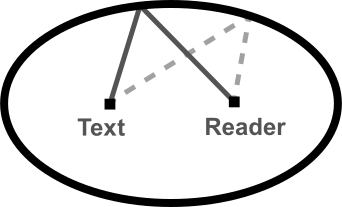
Perhaps you remember how the geometrical shape of an ellipse has, not one fixed central point like a circle, but two? Each of the two fixed points is called a focus or "center of attraction". At any point along the orbit of the ellipse, the sum of the distance from there to Focus A plus the distance to Focus B is always the same.
Now visualize an ellipse with Focus A called "the Text" and Focus B called "the Reader," as in Figure 1. The ellipse itself represents the interpretation or meaning of the message. All the points—i.e., all possible meanings or interpretations—along the right-hand side of the ellipse are closer to the Reader, and all the points on the left-hand side are closer to the Text. Some interpretations are more reader-oriented and some are more text-oriented, but every interpretation includes some degree of two-way interaction between both text and reader. Just as on the geometrical ellipse every point is constrained by both Focus A and Focus B, so the Biblical text cannot achieve meaning without input from a reader, and the reader cannot assign meaning until interacting with the text.
As mentioned above, much of this interaction occurs through codes. The writer has encoded the text with his or her own codes of communication. The reader derives meaning from the text by decoding it. However the reader's code system is invariably different from the writer's, resulting in varying differences in meaning between the time it is coded and the time it is decoded.
To summarize, every text means something; it cannot mean just anything, or everything, or nothing; it is not totally arbitrary. So, the text of the Bible means something; it is not without any meaning at all. But the meaning is implicit rather than explicit, hidden rather than self-revelatory, coded rather than open, until some informed reader lays hand on it and perceives it, or interacts with it, and concretizes, or realizes it.
Only then does the text come alive and demonstrate a meaning, or perhaps several meanings on different levels. Because this complex process can produce multiple meanings, readers should be prepared to trust those meanings so long as they fall within reasonable parameters.
Keeping Reader Interpretation Within Reason
What is there to keep the individual reader from going far astray in his or her individual interpretation of the meaning of the writing? This question is particularly relevant to the matter of a wild and totally unrestrained interpretation to the Bible by extremist individuals and cults. It is Stanley Fish who offers a helpful answer to the question.
Part of Professor Fish's answer is found in his proposal of what he calls "the Interpretative Community." M. H. Abrams, does not agree with Fish on many of his conclusions, but he does agree on this one. Abrams acknowledges that "Stanley Fish seems to me right in his claim that the linguistic meanings we find in a text are relative to the interpretive strategy we employ, and that agreement about meanings depends on membership in a community which shares an interpretive strategy" (294).
When applying the concept of interpretative community, most people naturally think of their own church. A Roman Catholic will think of the Roman Catholic Church, and a mainline Protestant will imagine the mainline historical Protestant Churches or denominations. Similarly, the ecumenically-minded will refer to the church universal, made up of all the redeemed in Christ from all ages and all parts of the earth. Other interpretative communities would be the Church of England, the United Methodist Church, the Presbyterian church, or perhaps one of the synods of the Lutheran Church. Other religious faith groups will have their own understanding of the concept and will define and apply it in their own way.
Not all members of a religious denomination will select the same group as their interpretative community. So Christians might define communities ranging from the local church, to an organized denominational body, to the universal church. However, they most likely will select a group that has some legitimacy or authority when they think of "the interpretative community" in the way Stanley Fish uses the term.
This legitimacy of the interpretative community serves as a flashing yellow light on the road to biblical interpretation. Most well-informed religious believers conceive that interpretation should be left as freely as possible to the individual conscience. But they see it checked to some extent by what other knowledgeable members of their religious community have come to accept as reasonable and acceptable. Although there is room for diversity of opinions up to a point, beyond that, general agreement of meaning usually occurs among those who share similar viewpoints and reading strategy. This is basically what Fish is saying about reading in general, and is what most informed believers and Bible scholars affirm regarding their scriptures. The flashing yellow light allows considerable freedom while at the same time imposing responsible discipline on those who might otherwise go speeding out of control.
Interpretative communities also act as red lights. Mark Allan Powell argues that within the various interpretative communities any perverse and absolutely heretical reading would undoubtedly be recognized as being out of accord with the accepted strategy of the larger religious community. This would not be grounds for persecution of the offenders, but it might be grounds for declaring that they are simply not in accord with the philosophy and strategy of the larger body.
Although a reader might make a reasonable interpretation through the influence of his interpretative community, he nevertheless remains obligated on a personal level to be wary of beguiling text. To recall an earlier example, he should not fall prey to text that might read "the stones were nearly black" when the author really means "the stones were nearly white." The following is a comprehensive example.
In his excellent book, Surprised by Sin: the Reader in Paradise Lost, Fish contends that Milton's method in this great epic "is to re-create in the mind of the reader … the drama of the Fall, to make him [that is, the reader] fall again exactly as Adam did and with Adam's troubled clarity, that is to say, 'not deceived'." It is not only many good readers of Paradise Lost, but many excellent literary critics like A. J. A. Waldock, who have wrongly chosen Satan as the great heroic figure in the epic. Those critics have been shown to be incorrect by Fish, C. S. Lewis, and other distinguished literary critics.
The avenue of approach taken by Fish is that Milton gets the reader so involved in the text that he is ensnared in Satan's rhetoric and is deceived by Satan much as Adam was. Fish says that "Milton consciously wants to worry his reader, to force him to doubt the correctness of his responses" (4). Whenever Satan appears to show courage, fortitude, endurance, and remarkable powers, Milton's literary persona follows the voice of Satan with a comment which should be a warning to the reader not to be deceived by "th' Apostate Angel … Vaunting aloud." Fish suggests that Milton's intention is to discount the effect of Satan's speeches and actions, and to correct the reader's entanglement in Satan's crusade of deceit (5). The telling epilogue is that all too often the readers do become entangled with the specious logic and alluring magnetism of a shrewd author's craft. The reader is not always almighty. The text, too, is powerful. In reader-oriented analysis, both must interact.
Receiving Transmitted Messages
Although we propose that Jason learn to use reader-oriented analysis, we must warn him that his attempt to analyze can fail abjectly if he tries to single out individual words or small phrases for interpretation. He must interact with the text by considering words that are grouped in correlation with the writer's thought patterns.
This centrality of the matter of reading and of the reader's interaction with the text has been analyzed persuasively by Wolfgang Iser, Professor of English and Comparative Literature at the University of Konstanz. He is the author of The Implied Reader: Patterns of Communication in Prose Fiction from Bunyan to Beckett, and of The Act of Reading: A Theory of Aesthetic Response. In The Implied Reader he says:
The [literary] work is more than the text, for the text only takes on life when it is realized, and furthermore the realization is by no means independent of the individual disposition of the reader…. The convergence of text and reader brings the literary work into existence.
While Iser emphasizes a reader-centered approach to literary analysis, he does not insist that the reader takes the sole or full initiative in the reading process. He points out in The Act of Reading that while the "literary texts take on their reality by being read … this in turn means that texts must already contain certain conditions of actualization that will allow their meaning to be assembled in the responsive mind of the recipient" (34). In other words, there is something (or some things) in the text that predisposes the reader to come to a certain meaning, or set of meanings. This is consistent with a solid view of biblical hermeneutics (science of interpreting). The mind of the reader must be involved with the text he or she is reading. The floating mind is not free to invent novel meanings out of thin air.
Any interesting and moving text has something in it put there by the author or writer which represents a perspective view of the world. Accordingly, Iser contends that "the text must therefore bring about a standpoint from which the reader will be able to view things that would never have come into focus as long as his own habitual dispositions were determining his orientation" (The Act of Reading 35). This is particularly evident in the novel, but it is also found in shorter literary works. The skilled author builds factors into the work which "draw the reader inescapably into the world of the text" (36).
Another of Iser's contributions is identification of the gestalt image as part of the reading process. The reader obtains this image by interpreting a whole message that possesses properties not derivable from its parts or their simple sum. When reading a book, a foreground is composed against a background. The reader's interaction between the foreground and background is synthesized into a new grouping, which completes that portion of the communication process. This new grouping can be so distinct that, when hearing a speech or reading a book it is difficult to tell the difference between what is presented and what is triggered in our minds by a memory or projection of our own.
Iser borrows from a European colleague in concluding, "there are some meanings that cannot be grasped merely by the direct or indirect decoding of letters or words, but can only be compiled by means of grouping" (119). He reminds us that when we read a printed page, our eyes do not focus on every letter or every word, but only on two or three points per line of copy. The human eye is not like a computer, and can not scan each individual letter. We read by glancing on groups of words. The brain, not the eye, fills in the rest of the foreground and background.
Without this faculty we would not be able to read as we do. Our eyes would see Individual letters of the alphabet, numerals, and words standing alone as unrelated objects. This would provide little meaning to our brain, because the meaning comes from phrases, clauses, groups of words, and, best, thoughts and concepts predicated by complete sentences. Without this linkage between eyes and brain, a novice language student may know the dictionary meaning of every root word in a sentence, and yet be unable to translate the sentence.
Another observation that Iser passes on to us, perhaps more significant than we would think because of its utter simplicity, is that a "major difference between reading and all forms of social interaction is the fact that with reading there is no face-to-face situation" (166). The one big exception to this, if Christianity is true, as hundreds of millions confidently believe, is that when reading the Bible devotionally, and when reading and proclaiming this Word in worship, Christians meet God in a spiritual encounter that is more real to them than any social face-to-face meeting.
Conclusion
A person who treats the Bible only as literature can develop some form of trust through the tools of literary analysis. A believer like Jason, however, having access to those same tools, can use them consciously to help him more deeply trust the Bible, even with its obvious inaccuracies. As he learns to read the Bible critically, he will be able to differentiate the errors from the overall message. As this difference emerges, he will find no irreverence in reading the Bible critically. In fact, he will gain more reverence for the Bible's message than he ever had when he was trying to ignore errors that were diluting the message. Having shed his hypocrisy, he will find that he really can trust the Bible.